Dear Reader
This Blog has been superseded by Facebook.
I don't intend to post here any further because it is much easier to post on Facebook.
To continue to stay informed of key news and opinion articles essential to keeping abreast of issues affecting Jews around the world, designed to help busy people stay up-to-date, go to the Jewish Issues Watchdog Facebook Page. By clicking "Like" (at the top-left of the page), postings there will be added to your News feed on Facebook.
Thanks for your interest....
Warm regards
Steve Lieblich

Wednesday, June 05, 2019


Sunday, March 24, 2019
Britain, Denmark Announce Opposition to Anti-Israel Resolutions at UNHRC
From The Tower, 21 March 2019:
The British and Danish governments announced Thursday that they will oppose every United Nations Human Rights Council (UNHRC) measure on alleged Israeli violation of Palestinian human rights in the West Bank and Gaza under discriminatory Agenda Item 7.
British Foreign Secretary Jeremy Hunt said in an op-ed published in the Jewish Chronicle that,
“Two years ago, the United Kingdom said that unless the situation changed, we would vote against all texts proposed under Item 7. ...Sadly, our concerns have not been heeded. So I have decided that we will do exactly what we said: Britain will now oppose every Item 7 resolution. On Friday we will vote against all four texts proposed in this way.”
Danish Foreign Minister Anders Samuelsen announced similar measures Thursday, saying
“Denmark will vote NO to all resolutions under #HRC Item 7. ...It is fundamentally wrong that Israel as the only country in the world has an entire agenda item dedicated to it in the UN Human Rights Council.” He called Denmark’s opposition to the resolutions a matter “of principle.”
Agenda Item 7, a permanent fixture on the schedule, is exclusively devoted to discussing alleged human rights abuses in the West Bank and Gaza. Israel is the only country in the UNHRC with a dedicated council item.
The UNHRC is currently meeting in Geneva for its 40th session, in which member states will be voting on five anti-Israel resolutions, four of which fall under Agenda Item 7. The council is set to debate, among other issues, the results of an investigation which found that Israeli troops may have committed crimes in their response to weekly Hamas-orchestrated riots at the Israeli-Gaza border last year.
The United States Ambassador to Germany Richard Grenell denounced the council’s “singular, obsessive focus” on the Jewish State in a speech he gave Monday in Geneva. Legal experts also slammed the UNHRC for its one-sided, biased investigation.
“Instead of promoting reconciliation and compromise, Item 7 strengthens the hard and trampled road of self-righteousness, a narrative that one side alone holds a monopoly of fault,” Hunt wrote in the Jewish Chronicle. “A lasting peace would require the parties to acknowledge the wrong and harm committed by every side, requiring painful compromise by all.”
The foreign secretary announced further that Britain “will continue to press for the abolition of Item 7, which only undermines the credibility of the world’s leading human rights forum.”
Opposition to anti-Israel measures in the UNHRC has been growing. On Thursday, Austrian Ambassador to Israel, Martin Weiss, tweeted that his country will vote against the “Accountability Resolution” at the UNHRC. Austrian Chancellor Sebastian Kurz told a gathering of the AJC Jewish advocacy group in Brussels that “this resolution is politically biased against Israel,” Weiss said.
In February, Australia and Denmark slammed the UNHRC for singling out Israel when they spoke at the opening session of the council. The two nations urged the UNHRC to drop Agenda Item 7...
Friday, March 22, 2019
Jihadis and neo-Nazis — they have always been brothers
From The Australian, MARCH 22, 2019, by Henry Ergas:

.... The neo-Nazis are not the jihadis’ opposite. They are their twins.
Both inhabit parallel universes in which all the strings are pulled by powerful cabals; both exalt violence as a purifying force; both, in their millenarian fantasies, seek an end of days.
They are, in that sense, neither of the Left nor of the Right. After all, those terms, born almost accidentally in the French Revolution, were forged into their present significance by the democratic contest.
The Left, with its confidence in government and belief in human perfectibility, stood on one side of that contest; the Right, with its attachment to individual liberty and recognition of human frailty, occupied the other.
Between them occurred what could only be an endless conversation, the balance of power sometimes favouring one side, sometimes the other.
But that is not a conversation of which the jihadis and the neo-Nazis want any part. On the contrary, their objective is to eliminate it once and for all, replacing politics, the process by which we reconcile competing, ever-changing, visions of the good life, with a caliphate or Valhalla that is frozen in time.
Nor is that all they share. Both are consumed by a hatred of Jews, who are at the heart of the conspiracy theories that frame their view of the world.
There are, for sure, neo-Nazis who harbour a murderous rage against Muslim immigrants. But as political scientist George Hawley argues in his careful analysis of the alt-Right, “because it is so obsessed with race, the alt-Right does not really care about the tenets of Islam” — rather, it is anti-Semitic rants, and calls for the destruction of the “Zionist money power”, that dominate its websites.
Little wonder then that there is far-reaching co-operation between neo-Nazis and Islamic fundamentalists. Painstakingly documented by George Michael, an American political scientist who is an authority on extremism, the basis for that co-operation was bluntly stated by David Duke, a former grand wizard of the Ku Klux Klan:
But equally, in France, some of the most vicious anti-Semitic propaganda is spread by a double act which unites Dieudonne M’bala M’bala — a French comic of Cameroonian origin who has repeatedly condoned Islamist terrorism — with neo-Fascist writer Alain Soral. And just as European Holocaust deniers helped finance al-Qa’ida, so the Holocaust deniers now benefit from Turkish, Arab and Iranian largesse.
Of course, the Islamists and the neo-Nazis operate on a vastly different scale. As Michael says, “there is no real right-wing terrorist infrastructure to speak of; leaderless resistance — actually a sign of desperation — predominates”. Lacking state sponsors who could “offer intelligence, funds, sanctuaries, training facilities and other kinds of support, the effectiveness (of white supremacist movements) has been very limited”, and has been further undermined by the reluctance to engage in suicide operations.
Chronically split into warring factions and sub-factions, they are nowhere near developing the deep links with local communities that sustain the Islamists and allow them to mount complex attacks such as those in Paris.
Yes, the internet has been a boon to the neo-Nazis and the alt-Right more broadly. According to Hawley, the culture of anonymity has been especially important, encouraging people to air views they would otherwise never express in public; but anonymity also impedes the formation of durable membership structures, preventing the movements from translating an online presence into an effective fighting force.
That is not to deny that their prominence has grown, thanks largely to an intensely polarised political environment in which issues of collective identity have played an increasing role. Nonetheless, as both Hawley and Michael conclude, the amorphous cloud of their followers remains a fringe of the fringe, which, while profoundly abhorrent, poses a security threat that scarcely compares to that posed by the jihadis.
That certainly doesn’t mean the white supremacists should be ignored. There is, however, a risk that horrors such as the massacre in Christchurch will be used to deflect resources and public attention from the still pressing dangers of radical Islamism. As in Britain’s Labour Party, and increasingly among the Democrats in the US, a double standard seems to be evolving that treats radical Islamism and its anti-Semitism with kid gloves while damning those who confront it as bigots.
That makes it all the more troubling that the government decided to bar the entry into the country of Milo Yiannopoulos — who, as Hawley shows, has been a target of the alt-Right’s incessant hostility, not least because he denounces violence — while permitting Sheik Omar Abdel Kafi, a Holocaust denier who repeatedly calls on Allah to “take revenge of the Jews”, to tour Australia and vent his anti-Semitic ravings.
No doubt, the government has its reasons; but it is equally apparent that it has set a precedent that could haunt this country for years to come.
Instead of promoting harmony, it will encourage the cancer of hatred to take root and flourish.
Ultimately, US President Donald Trump is right in describing the white supremacists as “a small group of people;” he is wrong, however, to suggest they have “very, very serious problems”, as if their behaviour were due to mental illness.
Nothing comes more readily to the modern mind than to convert sin into sickness, absolving those who trample on the moral law of the burden of responsibility. But the perpetrators of the atrocities we have witnessed are not lunatics; whether cloaking their assault weapons in the mantle of prophet or of the master race, they know all too well what they are doing when they commit crimes we can neither adequately punish nor conceivably forgive.
They are, to use the old-fashioned term, evil. And be they Islamists or neo-Nazis, it is the duty of our democracies to call them out, and to do so as unwaveringly when it is contentious as when it is easy.
Illustration: Eric Lobbecke
.... The neo-Nazis are not the jihadis’ opposite. They are their twins.
Both inhabit parallel universes in which all the strings are pulled by powerful cabals; both exalt violence as a purifying force; both, in their millenarian fantasies, seek an end of days.
They are, in that sense, neither of the Left nor of the Right. After all, those terms, born almost accidentally in the French Revolution, were forged into their present significance by the democratic contest.
The Left, with its confidence in government and belief in human perfectibility, stood on one side of that contest; the Right, with its attachment to individual liberty and recognition of human frailty, occupied the other.
Between them occurred what could only be an endless conversation, the balance of power sometimes favouring one side, sometimes the other.
But that is not a conversation of which the jihadis and the neo-Nazis want any part. On the contrary, their objective is to eliminate it once and for all, replacing politics, the process by which we reconcile competing, ever-changing, visions of the good life, with a caliphate or Valhalla that is frozen in time.
Nor is that all they share. Both are consumed by a hatred of Jews, who are at the heart of the conspiracy theories that frame their view of the world.
There are, for sure, neo-Nazis who harbour a murderous rage against Muslim immigrants. But as political scientist George Hawley argues in his careful analysis of the alt-Right, “because it is so obsessed with race, the alt-Right does not really care about the tenets of Islam” — rather, it is anti-Semitic rants, and calls for the destruction of the “Zionist money power”, that dominate its websites.
Little wonder then that there is far-reaching co-operation between neo-Nazis and Islamic fundamentalists. Painstakingly documented by George Michael, an American political scientist who is an authority on extremism, the basis for that co-operation was bluntly stated by David Duke, a former grand wizard of the Ku Klux Klan:
“The real danger to all heritages is Jewish supremacism, which seeks to destroy every heritage but the Jewish heritage.”The result is that seemingly incongruous partnerships have developed. The most galling, given his comments about Australia, is the close alliance between Turkish President Recep Tayyip Erdogan’s Justice and Development Party and the political party founded by Hitler’s most ardent and violent Turkish supporters.
But equally, in France, some of the most vicious anti-Semitic propaganda is spread by a double act which unites Dieudonne M’bala M’bala — a French comic of Cameroonian origin who has repeatedly condoned Islamist terrorism — with neo-Fascist writer Alain Soral. And just as European Holocaust deniers helped finance al-Qa’ida, so the Holocaust deniers now benefit from Turkish, Arab and Iranian largesse.
Of course, the Islamists and the neo-Nazis operate on a vastly different scale. As Michael says, “there is no real right-wing terrorist infrastructure to speak of; leaderless resistance — actually a sign of desperation — predominates”. Lacking state sponsors who could “offer intelligence, funds, sanctuaries, training facilities and other kinds of support, the effectiveness (of white supremacist movements) has been very limited”, and has been further undermined by the reluctance to engage in suicide operations.
Chronically split into warring factions and sub-factions, they are nowhere near developing the deep links with local communities that sustain the Islamists and allow them to mount complex attacks such as those in Paris.
Yes, the internet has been a boon to the neo-Nazis and the alt-Right more broadly. According to Hawley, the culture of anonymity has been especially important, encouraging people to air views they would otherwise never express in public; but anonymity also impedes the formation of durable membership structures, preventing the movements from translating an online presence into an effective fighting force.
That is not to deny that their prominence has grown, thanks largely to an intensely polarised political environment in which issues of collective identity have played an increasing role. Nonetheless, as both Hawley and Michael conclude, the amorphous cloud of their followers remains a fringe of the fringe, which, while profoundly abhorrent, poses a security threat that scarcely compares to that posed by the jihadis.
That certainly doesn’t mean the white supremacists should be ignored. There is, however, a risk that horrors such as the massacre in Christchurch will be used to deflect resources and public attention from the still pressing dangers of radical Islamism. As in Britain’s Labour Party, and increasingly among the Democrats in the US, a double standard seems to be evolving that treats radical Islamism and its anti-Semitism with kid gloves while damning those who confront it as bigots.
That makes it all the more troubling that the government decided to bar the entry into the country of Milo Yiannopoulos — who, as Hawley shows, has been a target of the alt-Right’s incessant hostility, not least because he denounces violence — while permitting Sheik Omar Abdel Kafi, a Holocaust denier who repeatedly calls on Allah to “take revenge of the Jews”, to tour Australia and vent his anti-Semitic ravings.
No doubt, the government has its reasons; but it is equally apparent that it has set a precedent that could haunt this country for years to come.
Instead of promoting harmony, it will encourage the cancer of hatred to take root and flourish.
Ultimately, US President Donald Trump is right in describing the white supremacists as “a small group of people;” he is wrong, however, to suggest they have “very, very serious problems”, as if their behaviour were due to mental illness.
Nothing comes more readily to the modern mind than to convert sin into sickness, absolving those who trample on the moral law of the burden of responsibility. But the perpetrators of the atrocities we have witnessed are not lunatics; whether cloaking their assault weapons in the mantle of prophet or of the master race, they know all too well what they are doing when they commit crimes we can neither adequately punish nor conceivably forgive.
They are, to use the old-fashioned term, evil. And be they Islamists or neo-Nazis, it is the duty of our democracies to call them out, and to do so as unwaveringly when it is contentious as when it is easy.
Monday, March 18, 2019
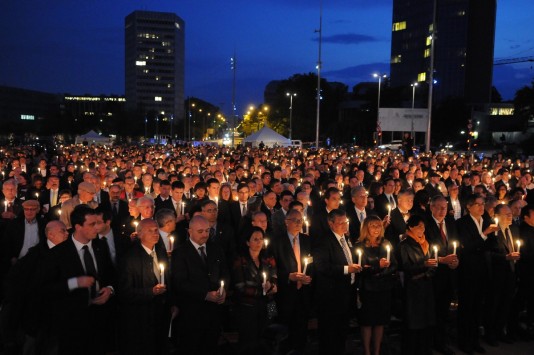
Monday: Historic Rally for Equal Rights to Protest UNHRC's 'Hate Israel Day'
|
|
|
Thursday, February 21, 2019
Benjamin B. Ferencz Continues His Fight for Justice at 98
From WSJ, 20 Feb 2019, by Samuel Rubenfeld:
Follow this link to see a 2-minute trailer

Benjamin B. Ferencz, shown here in 2014, is the last surviving prosecutor of the Nuremberg Trials. PHOTO: ROBIN UTRECHT
He dug up bodies of Jews buried in shallow graves, unearthing them however he could, the souls of those killed by Nazis during World War II. Sometimes by hand, sometimes with shovels, sometimes with the help of rope and the torque of a military vehicle.
In the days after the war, he toured concentration camps for the U.S. military, witnessing bodies in crematoriums stacked like cordwood and surviving inmates gnawing on garbage.
Benjamin B. Ferencz, a Jewish man from New York, had to suppress his horror to accomplish his mission: to collect evidence to convict Nazis of war crimes—an experience that left him with an unshakable purpose that would guide the rest of his life.
“I couldn’t possibly do the job if I let it get to me at that time,” Mr. Ferencz says in an interview at his New Rochelle, N.Y. home. “It’s remained with me ever since.”

Mr. Ferencz during the Einsatzgruppen Trial in Nuremberg in 1947. PHOTO: BEN FERENCZ PRIVATE COLLECTION
Mr. Ferencz, 98 years old, is the last surviving prosecutor of the Nuremberg Trials. His story is the subject of “Prosecuting Evil,” a documentary to be released later this month at Cinema Village in New York, with a wider release to follow. It has screened for Jewish audiences at New York’s Temple Emanu-El Streicker Center and in synagogues across the U.S., and for the general public at film festivals, including last year’s Toronto International Film Festival.
The documentary follows Mr. Ferencz’s life, his pursuit of justice and his decades of work building the underlying legal principles for international criminal law. Barry Avrich, who directed and produced “Prosecuting Evil,” calls the film the most important and fulfilling work of his career. “Ben should be recognized globally as a historical icon,” he says.
Much of the roughly 80-minute documentary is built from interviews with Mr. Ferencz about his life and the trial, accompanied by archival photos and video footage of Germany during and after the war. Others interviewed for the film, including Mr. Ferencz’s son Don, legal analysts and government officials, provide the context of Mr. Ferencz’s legacy in international criminal justice.
Mr. Ferencz was instrumental in the development of the International Criminal Court at The Hague, where individuals face prosecution for genocide, war crimes or crimes of aggression.
“This is one person, one great man in history who...continues to show that this world can be better,” says Fatou Bensouda, an international criminal law prosecutor at the court, in the film.
Those days in the concentration camps fueled Mr. Ferencz’s ongoing fight for the use of jurisprudence in mitigating international conflicts, decrying war as genocidal.
“War will take otherwise decent people and turn them into murderous killers,” Mr. Ferencz says. “No war is won; it’s not a ballgame.”
Born in Transylvania in 1920, Mr. Ferencz came to the U.S. as an infant with his sister and parents, fleeing persecution to settle in the Hell’s Kitchen neighborhood of Manhattan. He spoke Yiddish at home and wasn’t initially admitted to public school, because he couldn’t speak English. But, according to the documentary, teachers believed he was gifted and he was admitted to Townsend Harris High School, which had a program that included an opportunity to attend the City College of New York.
Mr. Ferencz attended Harvard Law School, where he conducted research for criminologist Sheldon Glueck, who at the time was writing a book about war crimes.

An image from the documentary ‘Prosecuting Evil,’ showing Mr. Ferencz in Munich in August 1945. PHOTO: BEN FERENCZ PRIVATE COLLECTION
Mr. Ferencz graduated law school in 1943, after the U.S. entered the war. He enlisted that year in the U.S. Army as a private, and eventually rose to the rank of sergeant, having fought as an antiaircraft artillery man in the European theater.
As Nazi atrocities were being uncovered, Mr. Ferencz received his final Army assignment: He became a war-crimes investigator, entering the concentration camps to gather evidence.
Mr. Ferencz says he prepared himself for the task as if he was personally directed by Gen. George S. Patton to enter the camps. “I couldn’t afford to be stopped by anything I saw,” he says.
Describing in the film what he saw in the camps, Mr. Ferencz stops, swallows hard and holds back tears. “It becomes vivid again,” he says. “I did my job, because that was my job.”

A general view of the trial of Nazi war criminals in Nuremberg in 1946. PHOTO: BETTMANN ARCHIVE/GETTY IMAGES
The Nuremberg Trials, as the documentary portrays in depth, were also a formative experience for him.
When he returned to New York after the war, he was recruited by Gen. Telford Taylor, then chief prosecutor of the Nuremberg Trials, to return to Germany and gather more evidence. Mr. Ferencz and his staff discovered dossiers of the Einsatzgruppen, Nazi death squads who murdered more than a million Jews, Roma, gay people and political opponents in Eastern Europe.
Mr. Taylor then assigned Mr. Ferencz to lead the prosecution of the Einsatzgruppen case, one of the dozen subsequent war-crimes trials held at Nuremberg and what Mr. Ferencz described as the biggest murder trial in human history. The defendants were Nazi officers and Gestapo members who had carried out the murders; Otto Ohlendorf, the chief defendant, was commander of one of the death squads.
At age 27, it was Mr. Ferencz’s first trial. Barely over 5 feet tall, he stood on a stack of books to deliver the opening statement—the moment is captured in video footage in the film—in which he said: “Vengeance is not our goal, nor do we seek merely a just retribution...the case we present is a plea of humanity to law.”
Mr. Ferencz presents evidence as chief prosecutor in the Einsatzgruppen Trial in 1947.
Mr. Ferencz presents evidence as chief prosecutor in the Einsatzgruppen Trial in 1947. PHOTO: US HOLOCAUST MEMORIAL MUSEUM/BENJAMIN FERENCZ
All of the men prosecuted by Mr. Ferencz were convicted, and many received death sentences.
Mr. Ohlendorf, who had a wife and five children, was executed by hanging. “Aside from the fact that he killed 90,000 Jews, I’m sure he was quite a gentleman,” Mr. Ferencz says in the film, reflecting on the man’s character.
After the trial, Mr. Ferencz took over the process of recovering the heirless, unclaimed assets of murdered Jews. In the years following the Nuremberg prosecutions, Mr. Ferencz returned to New York and practiced law, eventually becoming partners with Mr. Taylor and taking what he called “hopeless cases” that had a moral element he could pursue.

Otto Ohlendorf, center, during the Einsatzgruppen Trial. PHOTO: BETTMANN ARCHIVE/GETTY IMAGES
Mr. Avrich says when he showed Mr. Ferencz a rough cut of the film, Mr. Ferencz broke down crying and told him, “it’s all I need.”
Mr. Ferencz hopes the attention, including through the film, will help continue the fight for rule of law. It took decades to create the International Criminal Court, but he never gave up, even when people he trusted told him to stop trying, he says.
He says he seeks a more peaceful world for younger people because their lives are at stake.
“If we are repudiating law as an instrument of policy, you’re dooming the young people of the forthcoming generation—if there is one,” he says.
Follow this link to see a 2-minute trailer of the documentary
‘No War Is Won’
The last surviving prosecutor of the Nuremberg Trials is the subject of a new documentaryFollow this link to see a 2-minute trailer
Benjamin B. Ferencz, shown here in 2014, is the last surviving prosecutor of the Nuremberg Trials. PHOTO: ROBIN UTRECHT
He dug up bodies of Jews buried in shallow graves, unearthing them however he could, the souls of those killed by Nazis during World War II. Sometimes by hand, sometimes with shovels, sometimes with the help of rope and the torque of a military vehicle.
In the days after the war, he toured concentration camps for the U.S. military, witnessing bodies in crematoriums stacked like cordwood and surviving inmates gnawing on garbage.
Benjamin B. Ferencz, a Jewish man from New York, had to suppress his horror to accomplish his mission: to collect evidence to convict Nazis of war crimes—an experience that left him with an unshakable purpose that would guide the rest of his life.
“I couldn’t possibly do the job if I let it get to me at that time,” Mr. Ferencz says in an interview at his New Rochelle, N.Y. home. “It’s remained with me ever since.”
Mr. Ferencz during the Einsatzgruppen Trial in Nuremberg in 1947. PHOTO: BEN FERENCZ PRIVATE COLLECTION
Mr. Ferencz, 98 years old, is the last surviving prosecutor of the Nuremberg Trials. His story is the subject of “Prosecuting Evil,” a documentary to be released later this month at Cinema Village in New York, with a wider release to follow. It has screened for Jewish audiences at New York’s Temple Emanu-El Streicker Center and in synagogues across the U.S., and for the general public at film festivals, including last year’s Toronto International Film Festival.
The documentary follows Mr. Ferencz’s life, his pursuit of justice and his decades of work building the underlying legal principles for international criminal law. Barry Avrich, who directed and produced “Prosecuting Evil,” calls the film the most important and fulfilling work of his career. “Ben should be recognized globally as a historical icon,” he says.
Much of the roughly 80-minute documentary is built from interviews with Mr. Ferencz about his life and the trial, accompanied by archival photos and video footage of Germany during and after the war. Others interviewed for the film, including Mr. Ferencz’s son Don, legal analysts and government officials, provide the context of Mr. Ferencz’s legacy in international criminal justice.
Mr. Ferencz was instrumental in the development of the International Criminal Court at The Hague, where individuals face prosecution for genocide, war crimes or crimes of aggression.
“This is one person, one great man in history who...continues to show that this world can be better,” says Fatou Bensouda, an international criminal law prosecutor at the court, in the film.
Those days in the concentration camps fueled Mr. Ferencz’s ongoing fight for the use of jurisprudence in mitigating international conflicts, decrying war as genocidal.
“War will take otherwise decent people and turn them into murderous killers,” Mr. Ferencz says. “No war is won; it’s not a ballgame.”
Born in Transylvania in 1920, Mr. Ferencz came to the U.S. as an infant with his sister and parents, fleeing persecution to settle in the Hell’s Kitchen neighborhood of Manhattan. He spoke Yiddish at home and wasn’t initially admitted to public school, because he couldn’t speak English. But, according to the documentary, teachers believed he was gifted and he was admitted to Townsend Harris High School, which had a program that included an opportunity to attend the City College of New York.
Mr. Ferencz attended Harvard Law School, where he conducted research for criminologist Sheldon Glueck, who at the time was writing a book about war crimes.
An image from the documentary ‘Prosecuting Evil,’ showing Mr. Ferencz in Munich in August 1945. PHOTO: BEN FERENCZ PRIVATE COLLECTION
Mr. Ferencz graduated law school in 1943, after the U.S. entered the war. He enlisted that year in the U.S. Army as a private, and eventually rose to the rank of sergeant, having fought as an antiaircraft artillery man in the European theater.
As Nazi atrocities were being uncovered, Mr. Ferencz received his final Army assignment: He became a war-crimes investigator, entering the concentration camps to gather evidence.
Mr. Ferencz says he prepared himself for the task as if he was personally directed by Gen. George S. Patton to enter the camps. “I couldn’t afford to be stopped by anything I saw,” he says.
Describing in the film what he saw in the camps, Mr. Ferencz stops, swallows hard and holds back tears. “It becomes vivid again,” he says. “I did my job, because that was my job.”
A general view of the trial of Nazi war criminals in Nuremberg in 1946. PHOTO: BETTMANN ARCHIVE/GETTY IMAGES
The Nuremberg Trials, as the documentary portrays in depth, were also a formative experience for him.
When he returned to New York after the war, he was recruited by Gen. Telford Taylor, then chief prosecutor of the Nuremberg Trials, to return to Germany and gather more evidence. Mr. Ferencz and his staff discovered dossiers of the Einsatzgruppen, Nazi death squads who murdered more than a million Jews, Roma, gay people and political opponents in Eastern Europe.
Mr. Taylor then assigned Mr. Ferencz to lead the prosecution of the Einsatzgruppen case, one of the dozen subsequent war-crimes trials held at Nuremberg and what Mr. Ferencz described as the biggest murder trial in human history. The defendants were Nazi officers and Gestapo members who had carried out the murders; Otto Ohlendorf, the chief defendant, was commander of one of the death squads.
At age 27, it was Mr. Ferencz’s first trial. Barely over 5 feet tall, he stood on a stack of books to deliver the opening statement—the moment is captured in video footage in the film—in which he said: “Vengeance is not our goal, nor do we seek merely a just retribution...the case we present is a plea of humanity to law.”
Mr. Ferencz presents evidence as chief prosecutor in the Einsatzgruppen Trial in 1947.
Mr. Ferencz presents evidence as chief prosecutor in the Einsatzgruppen Trial in 1947. PHOTO: US HOLOCAUST MEMORIAL MUSEUM/BENJAMIN FERENCZ
All of the men prosecuted by Mr. Ferencz were convicted, and many received death sentences.
Mr. Ohlendorf, who had a wife and five children, was executed by hanging. “Aside from the fact that he killed 90,000 Jews, I’m sure he was quite a gentleman,” Mr. Ferencz says in the film, reflecting on the man’s character.
After the trial, Mr. Ferencz took over the process of recovering the heirless, unclaimed assets of murdered Jews. In the years following the Nuremberg prosecutions, Mr. Ferencz returned to New York and practiced law, eventually becoming partners with Mr. Taylor and taking what he called “hopeless cases” that had a moral element he could pursue.
Otto Ohlendorf, center, during the Einsatzgruppen Trial. PHOTO: BETTMANN ARCHIVE/GETTY IMAGES
Mr. Avrich says when he showed Mr. Ferencz a rough cut of the film, Mr. Ferencz broke down crying and told him, “it’s all I need.”
Mr. Ferencz hopes the attention, including through the film, will help continue the fight for rule of law. It took decades to create the International Criminal Court, but he never gave up, even when people he trusted told him to stop trying, he says.
He says he seeks a more peaceful world for younger people because their lives are at stake.
“If we are repudiating law as an instrument of policy, you’re dooming the young people of the forthcoming generation—if there is one,” he says.
Follow this link to see a 2-minute trailer of the documentary
Tuesday, February 19, 2019
Arab ministers defend Israel’s right to attack Iran, downplay Palestinian issue
From World Israel News, February 16, 2019, By Associated Press and World Israel News Staff:
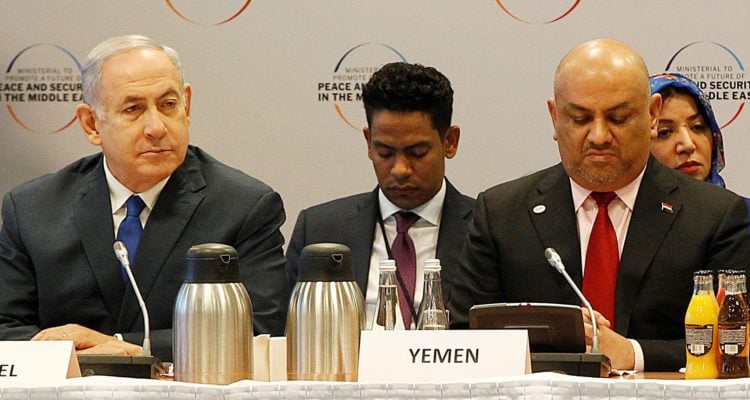 Israeli Prime Minister Benjamin Netanyahu and Yemen's Foreign Minister Khalid al-Yamani. (AP Photo/Czarek Sokolowski, File)
At a major Mideast summit in Warsaw this week, Arab leaders said the Iranian threat is the region’s most pressing challenge, dismissing the Palestinian issue’s relevance in comparison.
Israeli Prime Minister Benjamin Netanyahu’s office on Thursday [reported on] a closed meeting in which senior Gulf Arab officials supported Israel’s right to defend itself, played down the Israeli-Palestinian conflict, and described Iran as the greatest threat to regional peace.
...[He referred to a] series of comments made by officials from Bahrain, Saudi Arabia and the United Arab Emirates on a closed panel discussion at a U.S.-sponsored security conference in Warsaw. Some 60 nations participated in the gathering, which was focused heavily on countering Iran’s growing influence in the region.
Bahrain’s foreign minister, Khalid Al Khalifa, made some of the toughest comments, saying that Iran is a far bigger threat to regional security than the long-running Israeli-Palestinian conflict.
“We grew up talking about the Palestine-Israel dispute as the most important issue,” he said. “But then at a later stage, we saw a bigger challenge. We saw a more toxic one, in fact the most toxic in our modern history, which came from the Islamic Republic, from Iran.”
He went on to denounce the “neo-fascist regime” in Tehran, accusing it of plotting attacks in his country and destabilizing Yemen, Syria and Iraq.
‘Every nation has a right to defend itself’
Khalifa continued,
“When we come to Israel-Palestine, we had the Camp David agreement. There was Madrid. There were many other ways of solving it, had we stayed on the same path. If it wasn’t for the toxic party [Iran] … [and the] guns, food, [and] soldiers of the Islamic Republic, I think we would have been much closer today in solving this issue with Israel,” Khalifa said...
Asked about Israel’s military activity in Syria, the UAE’s Emirati Foreign Minister Abdullah bin Zayed Al Nahyan, commented,
“Every nation has the right to defend itself when it’s challenged by another nation.”
Saudi Arabia’s minister of state for foreign affairs, Adel al-Jubeir, also accused Iran of hurting the Palestinian cause by supporting terror groups battling Palestinian President Mahmoud Abbas.
“Who is supporting Hamas and [Palestinian] Islamic Jihad and undercutting the Palestinian Authority?...Iran.”
Netanyahu did not participate on the panel, but is seen sitting in the audience. Speaking to reporters early Thursday, Netanyahu hinted at the “unfathomabl[y]” friendly atmosphere at the conference.
Iran: the greatest regional threat
Israel has identified Iran as its greatest threat...
“Once the Palestinian issue took center stage. Now [the Arab states] say that first and foremost the Iranian issue needs to be dealt with,” Netanyahu commented ...
“Four out of five Arab foreign ministers who addressed the conference [on Thursday] spoke strongly and clearly against Iran, saying exactly what I’ve been saying for years. They were as clear as possible about the issue, and Israel’s right to defend itself against Iranian aggression,” he explained.
Netanyahu identified the Arab representatives’ mere decision to remain in the room when he spoke, breaking from standard protocol in the past of getting up and walking out when an Israeli leader speaks, represented “the breaking of a taboo.”
“Here you have Arab foreign ministers, who say that Israelis have the right to defend themselves, and don’t say it in secret but on a stage with 60 other countries present...”
Monday, February 18, 2019
Benny Gantz’s Dangerous Ambiguity on West Bank Disengagement
From BESA Center Perspectives Paper No. 1,091, 18 Feb, 2019, by Gershon Hacohen:
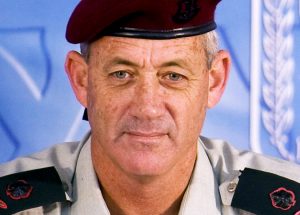
Benny Gantz, photo via Wikimedia Commons
Unilateral disengagement from the West Bank, which Israeli PM candidate Benny Gantz seems to support, would have far-reaching adverse implications for Israel in the security, economic, social, infrastructural, and ecological spheres.
For all his efforts to keep his views on key national issues under wraps, so as to make his premiership bid appealing to the largest possible number of Israelis, former IDF Chief of Staff Benny Gantz has indicated his readiness to apply the highly controversial unilateral disengagement formula that Sharon applied to Gaza in 2005 to the West Bank as well.
“We need to find a way in which we’re not controlling other people,” Gantz told the daily Yediot Ahronot in his first interview as a PM candidate. “[The unilateral disengagement] was a legal move, a decision made by the Israeli government and carried out by the IDF and the settlers in a painful, but good manner. We need to take the lessons learned and implement them elsewhere.”
Leaving aside the ambiguity of these well-worn terms (e.g., most of the world views Jewish neighborhoods in east Jerusalem as “settlements” while Israelis consider them an integral part of Israel), or the feasibility of evacuating some 140,000 Jewish residents from their homes with no Palestinian quid pro quo, Gantz’s thinking seems to be predicated on dated suppositions that have long been overtaken by events.
The political and strategic precepts underlying the Oslo “peace” process, which Gantz echoes, vanished long ago. The PLO has unequivocally revealed its true colors: its total disinterest in peace, unyielding rejection of the idea of Jewish statehood, and incessant propensity for violence and terrorism. The US, which rose to world preeminence after the disintegration of the Soviet Union and the east European bloc, has largely lost this status over the past decade, while Russia has recovered much lost ground and regained a firm military and political foothold in the Middle East. Tehran is rapidly emerging as regional hegemon, with its tentacles spreading from Yemen and Iraq to the Mediterranean Sea and its dogged quest for nuclear weapons continuing apace under the international radar. Even the terror groups of Hezbollah and Hamas pose a far greater threat to Israel’s national security than they did a decade ago. Under these circumstances, Israel’s withdrawal from the West Bank’s Area C would constitute nothing short of an existential threat.
Nor does Israel need to find a way to stop “controlling other people,” as Gantz put it, for the simple reason that its control of the Palestinians ended some two decades ago. In May 1994 the IDF withdrew from all Palestinian population centers in the Gaza Strip. In January 1996 it vacated the West Bank’s populated areas (the Oslo Accords’ Areas A and B), comprising over 90% of the West Bank’s Palestinian residents, and handed control of that population to the Palestinian Authority (PA).
Effectively realizing PM Rabin’s vision of ending Israel’s control of the Palestinians without creating a fully-fledged Palestinian state, this move should have ended the debate about the supposed contradiction between Israel’s Jewish and democratic nature. These territories (Gaza and Areas A & B) are to all intents and purposes independent entities that will never become a part of Israel.
This in turn means that the real dispute between Israel and the Palestinians, as well as within Israel itself, no longer revolves around the end of “occupation” but around the future of East Jerusalem and Area C. And since Area C (which is home to only 100,000 Palestinians) includes all Jewish West Bank localities, IDF bases, transportation arteries, vital topographic sites, and habitable empty spaces between the Jordan Valley and the Jerusalem metropolis, its continued retention by Israel is a vital national interest. Why? Because its surrender to a potentially hostile Palestinian state would make the defense of the Israeli hinterland virtually impossible – and because these highly strategic and sparsely populated lands are of immense economic, infrastructural, communal, ecological, and cultural importance, not to mention their historical significance as the bedrock of the millenarian Jewish ancestral homeland.
PA SCHOOLS TEACHING HATE
From JPost, 8 Feb 2019, by Ben Bresky:
Maps erase Israel, math problems involve Palestinian causality figures, and militaristic images are found in PA textbooks being used in UN schools, report states.
A declassified document from the United States Government Accountability Office says that schools in Palestinian Authority areas run by UNWRA have an anti-Israel bias, bordering on incitement to violence.
The report was published in 2018 and made available this week to the public after two congress members called for its release.
Congressman Scott Perry (R-PA) and Congressman Lee Zeldin (R-NY) requested the full 65-page report of “West Bank and Gaza: State Monitors Textbook Content but Should Improve Its Reporting to Congress GAO-18-227C: Published: April 26, 2018." The congressmen commented on the report's contents in a press release Thursday.
The two congressmen called the report "damning." In one section, the report states that "more than half of the neutrality / bias issues it found were related too one of the following three categories -- maps, Jerusalem and cities -- for example, regional maps that exclude Israel and refer to Israeli cities as Palestinian."
Math problems found in textbooks were also found to be "problematic" and "not aligned with UN values." The report explained, "a specific math problem using the number of Palestinian casualties in the first and second intifadas (uprisings) was clearly objectionable."
US officials found "material that ignores Israeli narratives, includes militaristic and adversarial imagery, and preaches the values of resistance."
Congressman Scott Perry said, “The declassification of this report is a win for government transparency and the American public. The UNRWA textbook report sheds light on how misreporting from the Department of State directly interfered with the ability of the US Congress to conduct its constitutionally vested oversight."
The report was based on an earlier study recently issued by the Jerusalem-based Institute for Monitoring Peace and Cultural Tolerance in School Education [IMPACT-SE] which found that the latest Palestinian Authority elementary school textbooks are even more radical than previous editions. The IMPACT-SE report was based on examination of elementary-school grades one through four and high-school grades 11 and 12 of the 2016-2017 PA’s educational curriculum.
UNRWA has provided assistance to Palestinians in Israel and other countries since 1949. The Trump administration in August 2018 cut all funding to the agency questioning the organization's "fundamental business model" of servicing an "endlessly and exponentially expanding community" of declared Palestinian refugees.
Maps erase Israel, math problems involve Palestinian causality figures, and militaristic images are found in PA textbooks being used in UN schools, report states.
A declassified document from the United States Government Accountability Office says that schools in Palestinian Authority areas run by UNWRA have an anti-Israel bias, bordering on incitement to violence.
The report was published in 2018 and made available this week to the public after two congress members called for its release.
Congressman Scott Perry (R-PA) and Congressman Lee Zeldin (R-NY) requested the full 65-page report of “West Bank and Gaza: State Monitors Textbook Content but Should Improve Its Reporting to Congress GAO-18-227C: Published: April 26, 2018." The congressmen commented on the report's contents in a press release Thursday.
"It is unacceptable that the textbooks that are used delegitimize Israel and demonize the Jewish people, it is unacceptable that this program attempts to engrain this hatred in the hearts of children," Rep. Zeldin stated. "American’s hard earned money went towards its funding and it is unacceptable that the State Department lied to Congress about these very realities."Schools run by the United Nations Relief and Works Agency (UNRWA) have come under heavy criticism for years culminating in the Trump administration withdrawing funding from the agency. In February, the US announced its decision to de-fund the Palestinian Authority via its USAID program.
The two congressmen called the report "damning." In one section, the report states that "more than half of the neutrality / bias issues it found were related too one of the following three categories -- maps, Jerusalem and cities -- for example, regional maps that exclude Israel and refer to Israeli cities as Palestinian."
Math problems found in textbooks were also found to be "problematic" and "not aligned with UN values." The report explained, "a specific math problem using the number of Palestinian casualties in the first and second intifadas (uprisings) was clearly objectionable."
US officials found "material that ignores Israeli narratives, includes militaristic and adversarial imagery, and preaches the values of resistance."
Congressman Scott Perry said, “The declassification of this report is a win for government transparency and the American public. The UNRWA textbook report sheds light on how misreporting from the Department of State directly interfered with the ability of the US Congress to conduct its constitutionally vested oversight."
The report was based on an earlier study recently issued by the Jerusalem-based Institute for Monitoring Peace and Cultural Tolerance in School Education [IMPACT-SE] which found that the latest Palestinian Authority elementary school textbooks are even more radical than previous editions. The IMPACT-SE report was based on examination of elementary-school grades one through four and high-school grades 11 and 12 of the 2016-2017 PA’s educational curriculum.
“The release of this report puts to rest the myth that UNRWA is teaching an alternative, less radical curriculum to the children in its care," [IMPACT-SE] CEO Marcus Sheff said. "The report clearly states that while UNRWA may have created complementary materials in an attempt to cover up some of the hate in the PA curriculum, these materials never saw the light of day. They were not distributed, nor were teachers instructed in their use."...Many of the textbooks reached the hands of US officials through David Bedein of the Jerusalem based Center for Near East Policy Research. Bedein personally met with Yasser Arafat, the late head of the Palestinian Authority in 1996 as part of a special delegation and requested the textbooks. "Since then we've [examined] every textbook for the past 20 years," Bedein told The Jerusalem Post. He said school children were being taught to look up to Dalal Mughrabi, a perpetrator of the 1978 Coastal Road massacre in Israel, among other concerns.
UNRWA has provided assistance to Palestinians in Israel and other countries since 1949. The Trump administration in August 2018 cut all funding to the agency questioning the organization's "fundamental business model" of servicing an "endlessly and exponentially expanding community" of declared Palestinian refugees.
Thursday, February 07, 2019
The UAE Will Triumph Over Iran in the Next Middle Eastern War
From The National Interest, 19 Jan 2019, by Michael Rubin:
As Iranian bluster again increases, it could very well be Abu Dhabi that teaches Tehran a permanent lesson.
The eleventh annual Council on Foreign Relations’ “Preventive Priorities Survey” once again stated the obvious :
“Conflict between the United States and Iran as well as between the United States and China constitute two of the greatest threats to peace in 2019.”
Certainly, Washington and Tehran appear on a collision course. The risk is not that the United States will pre-emptively launch an attack on Iran—as much as the Trump administration seeks to isolate and pressure Iran, that simply is not on the table—but rather than the United States and Iran might stumble into conflict.
It has now been more than thirty years since Operation Praying Mantis , the last major direct confrontation between the U.S. and Iranian militaries. While that event—the largest surface naval engagement since World War II—left Iran severely chastened, there has now been a generation change in the Iranian military: the most junior conscripts from 1988 are now retired, and new commanders have risen through the ranks indoctrinated into the Islamic Revolutionary Guard Corps (IRGC) without any reality check to their rhetoric.
Traditionally, despite its problems with the IRGC Navy, the U.S. Navy has maintained professional, cordial relations with the regular Iranian Navy. That may now be a thing of the past; when Hossein Khanzadi replaced Habibollah Sayyari in November 2017 as head of the Islamic Republic of Iran Navy, Khanzadi promised to “wave the flag of our country right on the United States’ doorstep.” Alireza Tangsiri, who replaced the Ali Fadavi as head of the IRGC Navy in August 2018, remains a largely unknown quantity. Simply put, the danger that Iranian bluster or unpredictability might spark a cascade of conflict is increasing.
Traditionally, despite its problems with the IRGC Navy, the U.S. Navy has maintained professional, cordial relations with the regular Iranian Navy. That may now be a thing of the past; when Hossein Khanzadi replaced Habibollah Sayyari in November 2017 as head of the Islamic Republic of Iran Navy, Khanzadi promised to “wave the flag of our country right on the United States’ doorstep.” Alireza Tangsiri, who replaced the Ali Fadavi as head of the IRGC Navy in August 2018, remains a largely unknown quantity. Simply put, the danger that Iranian bluster or unpredictability might spark a cascade of conflict is increasing.
Then, of course, there is Hezbollah. It is hard to dismiss the threat to Israel posed by Hezbollah’s re-armament in contravention of UN Security Council Resolutions nor the recent discovery of tunnels dug under the nose of UN monitors. While Israel bloodied Hezbollah in 2006, Hezbollah’s participation in the Syrian Civil War has left it battle-hardened and more capable than most Arab armies. Hezbollah’s involvement in Syria, meanwhile, should also put to rest the notion that it is a Lebanese nationalist organization rather than a proxy answering to Iran.
As the Islamic Republic’s proxy, Hezbollah remains the tip of the spear again Israel. The situation is a powder keg: if Hezbollah can conduct operations without suffering retaliation, then Hezbollah can depict Israel as weak. If Hezbollah can draw Israel into a conflict in Lebanon, Iranian leaders see advantage. And, for Tehran, a Hezbollah barrage of rockets (or UAVs) into Israel represents a win-win situation: either they hit targets in Israel or Israel’s anti-missile defenses intercept them. Forcing Israel to activate Iron Dome, however, is no defeat, especially given the discrepancy in cost between Hezbollah rockets and Iron Dome interceptors.
As the Islamic Republic’s proxy, Hezbollah remains the tip of the spear again Israel. The situation is a powder keg: if Hezbollah can conduct operations without suffering retaliation, then Hezbollah can depict Israel as weak. If Hezbollah can draw Israel into a conflict in Lebanon, Iranian leaders see advantage. And, for Tehran, a Hezbollah barrage of rockets (or UAVs) into Israel represents a win-win situation: either they hit targets in Israel or Israel’s anti-missile defenses intercept them. Forcing Israel to activate Iron Dome, however, is no defeat, especially given the discrepancy in cost between Hezbollah rockets and Iron Dome interceptors.
Still, the Islamic Republic should not misjudge Israel. The threat of Hezbollah missiles is the main deterrent to any Israeli strike on Iran. Should Hezbollah launch them first, then such disincentive to decision-makers in Jerusalem to launch an attack diminishes. Even if Israel does not launch airstrikes against Iran, it has submarines in the northern Indian Ocean capable of launching missile strikes to paralyze Iranian command-and-control, its nuclear sites, and its military bases.
Debate over the effectiveness of any Israeli strike on Iran is where discussion of such scenarios usually end. The Middle East, however, is more than just Iran and Israel. The greatest change in Middle Eastern balance-of-power over the last decade hasn’t been with you regard to Israel or Iran, but rather the rise of the United Arab Emirates (UAE).
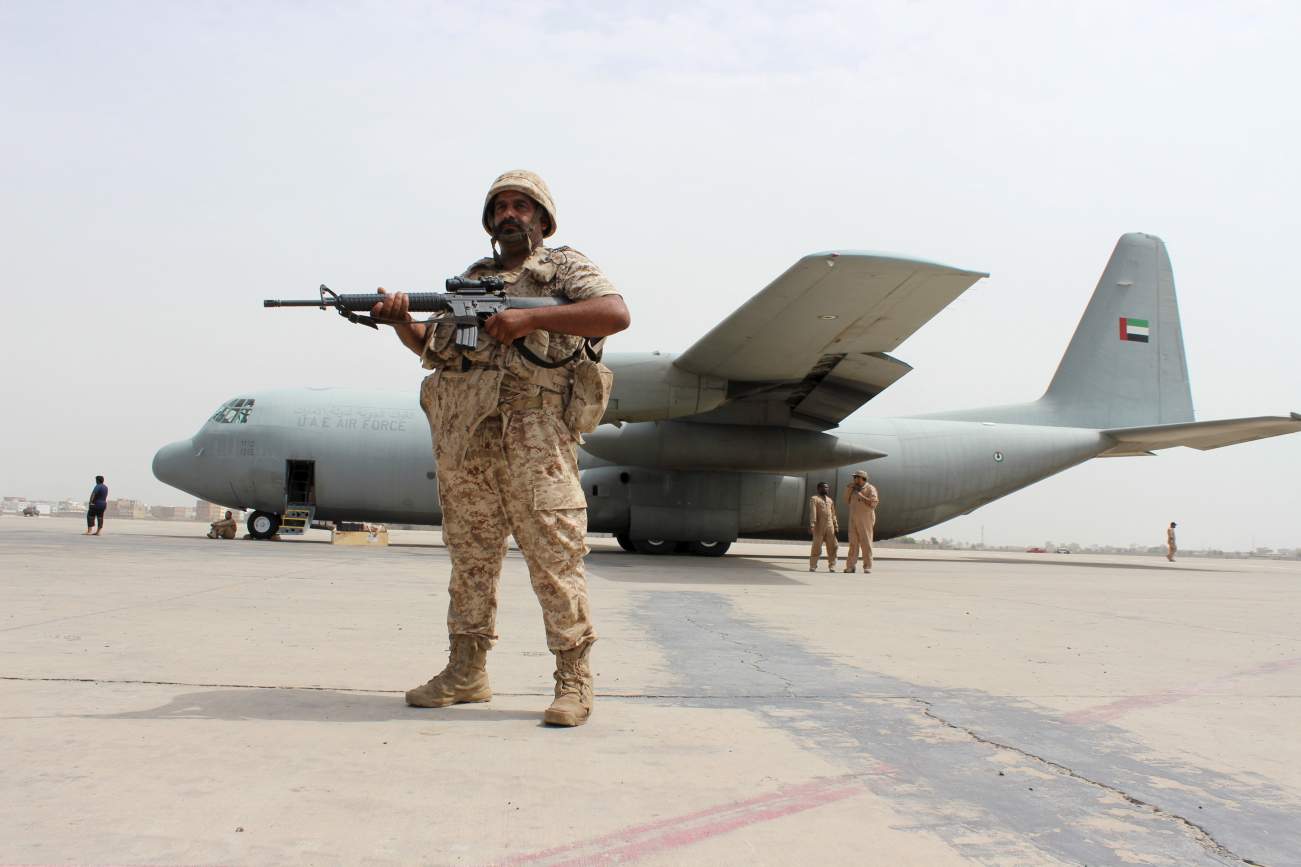
While many journalists and Western analysts condemn Saudi Arabia for its botched intervention in Yemen, they ignore that the UAE has largely been successful: it has pushed back Al Qaeda in the Arabian Peninsula and, after much delay, UAE forces are on the verge of forcing Houthi militias out of Hodeida, the last major port the pro-Iranian group controlled. Simply put, the UAE is no longer just a lazy Gulf state showing off high-price purchases but unwilling to get its hand dirty.
While many journalists and Western analysts condemn Saudi Arabia for its botched intervention in Yemen, they ignore that the UAE has largely been successful: it has pushed back Al Qaeda in the Arabian Peninsula and, after much delay, UAE forces are on the verge of forcing Houthi militias out of Hodeida, the last major port the pro-Iranian group controlled. Simply put, the UAE is no longer just a lazy Gulf state showing off high-price purchases but unwilling to get its hand dirty.
But what could draw the UAE into a more direct conflict with Iran? Antagonism between the UAE and Iran dates back to before the Islamic Revolution. As the British withdrew from the Persian Gulf in 1971, Iranian troops invaded three islands even though international agreements awarded them to the UAE. Abu Musa is approximately fifty miles from the coast of Iran and forty miles from the coast of the UAE. It lies only ten miles from the Strait of Hormuz, however, and tanker traffic must pass between it and the Tunb Islands, amplifying Iranian strategic leverage. U.S. support for the Emirati claims to the islands is a bit hypocritical because the Nixon administration was willing to turn a blind eye to Iranian control given the close ties at the time between the shah and the White House. With revolutionaries in control in Tehran, however, the strategic calculus changed.
Post-revolution, Iranian authorities redoubled their presence on the islands, and Mohammad Ali Jafari, the commander of the IRGC, sometimes visits their garrisons. While the UAE has sought to negotiate from time to time and may soon again , such talks have gone nowhere.
Should Iranian behavior escalate into conflict with Israel or the United States, however, then the cost to Tehran may be the three islands. The UAE will not risk a direct fight with Iran now, but if Iran is engaged with more powerful foes, then the islands would be easy pickings. Surely, the IRGC garrisons on each would fight but, when they are cut off from resupply of ammunition, weapons, or food, even the most ideological Revolutionary Guardsmen may reconsider their willingness to fight.
The UAE would have little to fear from Iranian retaliation after the broader conflict ended. Defending the islands is easier than seizing them. While the IRGC is very good at asymmetric operations and sponsoring terror, marine landings are an entirely different skill set. The UAE of 2019 is far different than that of 1971. The fact that Abu Dhabi and Dubai hold hundreds of millions if not billions of dollars in Iranian investment is further disincentive to Tehran of launching direct operation or an anti-Emirati terror campaign. Iranian authorities are happy to fight to the last Palestinian or Lebanese, but when their own financial portfolios are at stake, their calculations change.
As Ayatollah Khomeini and an earlier generation of IRGC leaders learned ahead of Operation Praying Mantis, there can be a huge cost for confusing their own rhetoric with military reality. Any Israeli or U.S. military strike against Iranian nuclear or military sites would damage Iran’s air and naval operations for weeks or months but, from a broader strategic view, air strikes would simply kick disputes about Iran’s nuclear and ballistic missile program down the road, for the technological knowledge Iran has gained over the decades cannot be lost. Any military strike targeting Iran, meanwhile, would rally Iranians around the flag and, as with Saddam Hussein’s 1980 invasion, actually save a failing revolution.
EAPPI: The World Council of Churches’ Training Camp for Anti-Israel Advocacy
From NGO Monitor, 14 January 2019:
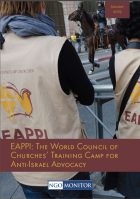
Executive Summary
- EAPPI, the World Council of Churches’ flagship project on Israel and the Arab-Israel conflict, has brought 1,800 volunteers to the West Bank to “witness life under occupation.” The World Council of Churches does not run similar activities in other conflict zones. By singling out Israel, EAPPI embodies antisemitism, as defined in the International Holocaust Remembrance Association’s working definition.
- Despite marketing itself as a human rights and protection program, EAPPI places significant emphasis on political advocacy before, during, and after the trip. When volunteers return to their home countries and churches, they engage in anti-Israel advocacy, such as BDS (boycott, divestment, and sanctions) campaigns and comparing Israel to apartheid South Africa and Nazi Germany.
- Participants are selected by country-specific non-governmental organizations (NGOs) known as “National Coordinators.” The National Coordinators are also active in BDS and other delegitimization campaigns against Israel.
- EAPPI receives funding from a variety of sources, including the WCC and National Coordinators. Funding from different governments is directed to EAPPI through the National Coordinators and via UNICEF.
- EAPPI contributes to a UN “Working Group” consisting of a number of UN agencies and NGOs that collaborate on and coordinate politicized anti-Israel campaigns in the West Bank. In this capacity, EAPPI does “a lot of administrative work which is fed into UN systems.”
- EAPPI partners with a number of political NGOs in the region, including groups that support BDS campaigns against Israel and/or that accuse Israel of “war crimes.”
- The significant problems with EAPPI, as laid out in this report, should be seen in light of the antisemitism1 and demonization that emerges from EAPPI’s parent body (World Council of Churches), partners, and affiliated staff.
Recommendations
To the donor governments – Act immediately to broadly reevaluate funding to EAPPI, in order to ensure that these funds are not misused to promote antisemitism, BDS, and lawfare, and/or to fuel the conflict. Donor governments must develop and implement transparent funding guidelines that are accountable to the public.
To the Israeli government – The Israeli government should develop a consistent, fact-based policy to deal with “delegimization” campaigns, which it defines as a strategic threat. It should engage in critical dialogue with the government donors, as well as with the churches involved with EAPPI.
To the WCC– If it desires to improve its image in Israel and with the global Jewish community, the WCC should not promote an ideology that denies Israel’s right to exist as a Jewish State and/or that discriminates against Christian supporters of Israel....
Wednesday, February 06, 2019
Trump and the Jewish People
From President Trump's State-of-the-Union address, 6 Feb 2019:

...To ensure this corrupt dictatorship never acquires nuclear weapons, I withdrew the United States from the disastrous Iran nuclear deal. And last fall, we put in place the toughest sanctions ever imposed on a country.
...To ensure this corrupt dictatorship never acquires nuclear weapons, I withdrew the United States from the disastrous Iran nuclear deal. And last fall, we put in place the toughest sanctions ever imposed on a country.
We will not avert our eyes from a regime that chants death to America and threatens genocide against the Jewish people. We must never ignore the vile poison of anti-Semitism, or those who spread its venomous creed. With one voice, we must confront this hatred anywhere and everywhere it occurs.
Just months ago, 11 Jewish-Americans were viciously murdered in an anti-semitic attack on the Tree of Life Synagogue in Pittsburgh. SWAT Officer Timothy Matson raced into the gunfire and was shot seven times chasing down the killer. Timothy has just had his 12th surgery -- but he made the trip to be here with us tonight. Officer Matson: we are forever grateful for your courage in the face of evil.
Tonight, we are also joined by Pittsburgh survivor Judah Samet. He arrived at the synagogue as the massacre began. But not only did Judah narrowly escape death last fall -- more than seven decades ago, he narrowly survived the Nazi concentration camps. Today is Judah's 81st birthday. Judah says he can still remember the exact moment, nearly 75 years ago, after 10 months in a concentration camp, when he and his family were put on a train, and told they were going to another camp. Suddenly the train screeched to a halt. A soldier appeared. Judah's family braced for the worst. Then, his father cried out with joy: "It's the Americans."
A second Holocaust survivor who is here tonight, Joshua Kaufman, was a prisoner at Dachau Concentration Camp. He remembers watching through a hole in the wall of a cattle car as American soldiers rolled in with tanks. "To me," Joshua recalls, "the American soldiers were proof that God exists, and they came down from the sky."...
Subscribe to:
Posts (Atom)